
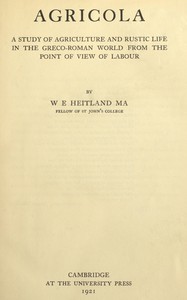
Agricola : A study of agriculture and rustic life in the Greco-Roman world…
Let's be clear from the start: this is not a novel. If you're picking up 'Agricola' expecting a sweeping historical drama, you'll need to adjust your expectations. Instead, think of it as a deeply researched and surprisingly readable investigation. William Emerton Heitland, writing over a century ago, acts like a detective piecing together fragments of evidence—from Roman farm manuals by Cato and Varro to legal texts and snippets of poetry—to answer one big question: what was it really like to live and work on the land in ancient Greece and Rome?
The Story
There's no traditional plot with characters and a climax. The 'story' here is the reconstruction of an entire way of life. Heitland systematically explores the practical realities: the crops they grew, the tools they used, and the animals they raised. He then moves to the human side, examining the social classes from enslaved laborers and tenant farmers to the wealthy estate owners. He looks at how religion, economics, and politics shaped their daily existence. The narrative tension comes from seeing how these societies solved (or failed to solve) eternal problems like soil depletion, labor management, and feeding a growing urban population. It's the story of civilization's foundation, told from the ground up.
Why You Should Read It
I'll admit, I initially thought this might be dry. I was wrong. Heitland has a clear, logical style and a genuine fascination with his subject that's contagious. The magic is in the details. Reading about the specific advice for planting olives or the legal rights of a tenant farmer makes that distant world suddenly tangible. You start to see the fingerprints of these ancient people on their environment. It completely changes how you view history. The battles and emperors feel like events happening far above the real, steady heartbeat of society: agriculture. This book gives a voice and a tremendous amount of dignity to the countless, nameless people whose labor made everything else possible.
Final Verdict
This is a niche book, but a brilliant one. It's perfect for history buffs who are tired of military campaigns and want to understand the engine room of the ancient world. It's also great for anyone interested in agriculture, sustainability, or social history. If you enjoy authors like Mary Beard who make the ancient world feel alive, you'll appreciate Heitland's foundational work. Just go in knowing it's a study, not a story. Bring your curiosity, and you'll be rewarded with a profoundly different perspective on Rome. It’s a book that makes you look at the land beneath your feet a little differently.
This is a copyright-free edition. Knowledge should be free and accessible.
Sandra Sanchez
2 months agoHaving read this twice, the clarity of the writing makes this accessible. I will read more from this author.
Emily Lewis
1 year agoHaving read this twice, the clarity of the writing makes this accessible. Truly inspiring.
Ava Miller
1 year agoNot bad at all.
Ava Scott
1 year agoComprehensive and well-researched.

Steven Clark
1 year agoTo be perfectly clear, it creates a vivid world that you simply do not want to leave. I learned so much from this.