
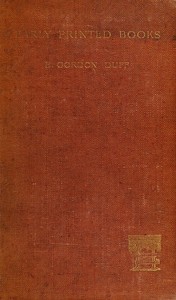
Early Printed Books by E. Gordon Duff
First things first: this isn't a novel. E. Gordon Duff's Early Printed Books is a guide, written over a century ago, to the first century of printing in Europe. Duff was a librarian and a true expert, and in this book, he acts as our tour guide through the 1400s and early 1500s. He walks us through the technical stuff—how those early presses worked, what the type looked like, how pages were laid out. But he also introduces us to the pioneering printers themselves, the adventurous men (and sometimes women) who set up shops from Mainz to Venice to London, risking their fortunes on this new technology.
The Story
There's no traditional plot, but there is a clear narrative: the explosive spread of an idea. The book starts with Johannes Gutenberg and his Bible, the famous 'first.' But Duff quickly moves on, showing how printing didn't stay in one place. It was like a spark hitting dry grass. He follows that spark across countries, showing how different printers put their own stamp on the craft. He talks about the books they chose to print—not just Bibles, but law texts, poetry, science, and scandalous pamphlets. The 'story' is the transformation of society because suddenly, knowledge could be copied exactly and shared widely for the first time in history.
Why You Should Read It
You should read it because Duff makes you feel the excitement of the new. When he describes holding a 'incunable' (a book printed before 1501), his awe is palpable. He isn't just cataloguing; he's connecting you to the moment a reader in 1480 might have felt, opening a mass-produced book for the very first time. It’s a book about the power of objects. He shows how the design of a book—the typeface, the margins, the illustrations—was part of its message. Reading this, you'll never look at a book's copyright page the same way again. You'll start to see the long shadow cast by those early printers in every paperback on your shelf.
Final Verdict
This is a perfect book for curious readers who love history, but want to see the human side of big changes. It's for the person who visits a museum and wonders about the people who made the artifacts, not just the kings who owned them. It's also surprisingly great for book design geeks and anyone in publishing—this is your industry's founding story. The writing is clear and direct (it's over 100 years old, so it's formal, but not difficult). Think of it as a long, brilliant conversation with a deeply knowledgeable friend about the most important invention you never think about. Keep your phone nearby to look up pictures of the beautiful books he describes—it makes the experience even richer.
This historical work is free of copyright protections. You can copy, modify, and distribute it freely.
Lisa Clark
1 year agoAfter finishing this book, it manages to explain difficult concepts in plain English. Absolutely essential reading.
Mason Scott
1 year agoFast paced, good book.




Ethan Ramirez
1 year agoI stumbled upon this title and the author's voice is distinct and makes complex topics easy to digest. I learned so much from this.