
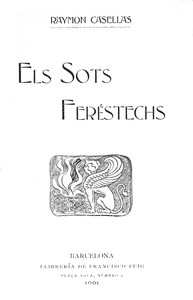
Els sots feréstechs by Raimón Casellas
Raimón Casellas's Els sots feréstechs (The Wild Ravines) is a novel that grabs you not with action, but with an overwhelming sense of place. Published in 1901, it’s a deep dive into a world where nature isn’t just a backdrop—it’s the engine of the story.
The Story
The plot is deceptively simple. Mossèn Llàtzer, a young and devout priest, is sent to serve in the parish of Sant Ponç. This isn't a quaint village; it's a collection of homes tucked into a deep, narrow valley where sunlight barely reaches. The people are hardened, isolated, and bound by old fears. Full of reformist zeal, Mossèn Llàtzer believes he can bring spiritual renewal and modern thought to this forgotten corner. But the valley itself—the damp, the shadows, the imposing cliffs—seems to resist him at every turn. His struggle isn't against a person, but against the pervasive gloom and the entrenched mindset it has fostered over generations. The book follows his gradual, heartbreaking realization that some shadows are too deep for any one man's light to dispel.
Why You Should Read It
This book stayed with me because of its incredible atmosphere. Casellas writes the landscape so vividly it becomes a physical presence. You feel the chill. You understand why the characters are the way they are. Mossèn Llàtzer’s journey is a tragic and deeply human one. It’s about the collision between idealism and a reality that’s literally set in stone. There’s no mustache-twirling evil here; the conflict is more profound and unsettling. It’s about how environment shapes culture, faith, and despair. Reading it feels like uncovering a secret, a piece of literary history that speaks powerfully to our connection (and often, our powerlessness) against the natural world.
Final Verdict
This is not a breezy beach read. It’s for the patient reader who loves Gothic atmosphere, psychological depth, and stories where the setting is the star. Think of it as a cousin to the works of Thomas Hardy or certain Spanish Generation of '98 writers, but with a uniquely Catalan soul. Perfect for fans of slow-burn literary fiction, anyone interested in naturalism, or readers looking to explore foundational works of Catalan literature. It’s a challenging, gloomy, and utterly magnificent portrait of a world apart.
The copyright for this book has expired, making it public property. Share knowledge freely with the world.
David Jackson
6 months agoJust what I was looking for.
Joseph Lewis
7 months agoHelped me clear up some confusion on the topic.
Jackson Robinson
9 months agoGreat read!
Margaret Young
10 months agoAfter hearing about this author multiple times, the clarity of the writing makes this accessible. Definitely a 5-star read.





Donna Lopez
2 years agoGood quality content.