
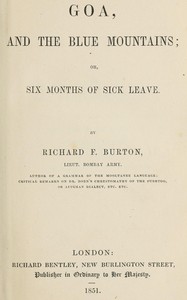
Goa and the Blue Mountains; or, Six months of sick leave by Burton
Okay, picture this: it's the mid-1800s, and Sir Richard Burton—famous linguist, spy, and all-around adventurer—is stuck in India with a bad case of something. The army gives him six months off to recover. Most people would take it easy. Burton packed a notebook and went exploring.
The Story
This book is his report from that 'break.' He first heads to Goa, the old Portuguese colony clinging to the coast. Burton walks its streets with a critical eye, describing the faded grandeur of its churches and the complex social mix of its people. He's not a tourist; he's an analyst, curious about how this European outpost functions (or doesn't) in India.
Then, seeking better air for his health, he journeys inland to the 'Blue Mountains'—the Nilgiri Hills. Here, the scene shifts completely. He lives among the indigenous Toda people, documenting their unique customs, architecture, and dairy-based culture with a detail that was rare for the time. The 'plot' is simply Burton's movement from one world to another: from a decaying colonial settlement to ancient tribal communities in the hills, with his sharp observations as the constant thread.
Why You Should Read It
You read this for Burton's voice. He's hilariously grumpy about bad roads and pompous officials, but genuinely respectful and fascinated by the Toda way of life. He doesn't just describe landscapes; he dissects power, religion, and culture. You feel like you're right beside him, getting the unfiltered, opinionated take of a man who found 'sick leave' boring. It's a time capsule, but a lively one. He makes the 19th century feel immediate and strangely familiar, especially when he complains about inefficiency or marvels at a beautiful view.
Final Verdict
This book is perfect for anyone who thinks old travel writing is stuffy. It's for readers who love character-driven nonfiction, where the author's personality is as big as the places he visits. History fans will appreciate the ground-level view of colonial India, and adventure readers will enjoy the spirit of a man who turned a doctor's order into an expedition. Just be ready for some Victorian-era attitudes mixed in with the brilliance. It's a fascinating, personal, and often very funny ride.
This digital edition is based on a public domain text. Share knowledge freely with the world.






Joseph Jones
2 months agoHaving read this twice, the clarity of the writing makes this accessible. I will read more from this author.