
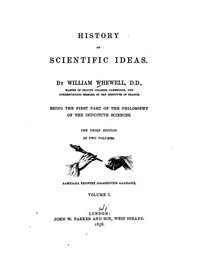
History of scientific ideas by William Whewell
William Whewell's History of the Inductive Sciences is a foundational work, but don't let that scare you off. It's not a simple timeline. Whewell wants to understand the engine of scientific progress itself. He walks us through major fields—astronomy, physics, geology—showing how each one stumbled forward. The pattern is always the same: a pile of confusing facts exists, then someone has a revolutionary idea that suddenly organizes them, like Kepler realizing planets move in ellipses, not perfect circles. That idea is then tested and refined against new facts. The 'plot' is this endless, productive tension between what we see and how we think.
Why You Should Read It
This book changed how I see science. Whewell makes a compelling case that science is a creative act, not just a mechanical one. The most powerful parts are where he shows scientists getting stuck because they lack the right 'concept' to even see the answer in front of them. It highlights the human element—the intuition, the stubbornness, the flashes of insight. You start to appreciate scientific revolutions not as inevitable, but as hard-won victories of imagination. It’s also a humbling reminder that our current scientific truths are just the latest 'happy guesses' that have held up—so far.
Final Verdict
This is for the curious reader who enjoys big ideas and intellectual history. It's perfect if you liked books like The Structure of Scientific Revolutions and want to see an earlier, foundational take on how science evolves. Be warned: it's a 19th-century text, so the prose can be dense in places, and some scientific examples are dated. But the core argument is timeless and brilliantly clear. If you're willing to put in a little work, you'll be rewarded with a profoundly different perspective on where knowledge comes from. Skip it if you want a light, narrative pop-science read. Embrace it if you want to grapple with the philosophy behind every great discovery.
This title is part of the public domain archive. You can copy, modify, and distribute it freely.
Melissa Brown
1 year agoWithout a doubt, the narrative structure is incredibly compelling. A true masterpiece.
Charles King
5 months agoThis is one of those stories where it manages to explain difficult concepts in plain English. Definitely a 5-star read.