
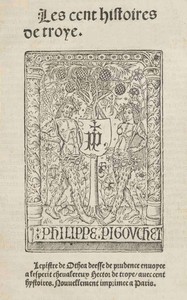
Les cent histoires de Troye : L'epistre de Othea deesse de prudence envoyee…
Let's be honest, a 600-year-old French allegorical poem doesn't sound like a page-turner. But Les cent histoires de Troye (The Hundred Stories of Troy), also known as L'epistre de Othea, is a surprise. It's built on a simple, clever idea. The goddess of wisdom, Othea, sends a letter to the young Trojan hero Hector. Her letter contains 100 short chapters. Each one gives Hector a piece of advice for becoming a wise knight and future ruler.
The Story
The structure is like a medieval toolkit for life. For each of the 100 points, Christine gives us three parts. First, a short verse telling a story from mythology or history—maybe about Jupiter, Hercules, or Achilles. Then, she explains the 'glose'—the moral lesson a knight should take from it. Finally, she adds an 'allegorie,' linking the story to Christian teachings. One story might warn against pride using the tale of Icarus, then connect it to spiritual humility. It's not a novel with a plot, but a guided tour through ancient wisdom, carefully curated to build a perfect prince.
Why You Should Read It
For me, the power isn't just in the ancient tales. It's in the voice of the teller. Christine de Pisan was a professional writer, a widow supporting her family with her pen in 1400s Paris. When she writes about good governance, justice, and the dangers of bad counsel, she's not just theorizing. She's commenting on the messy political world around her, a world sliding into civil war. She uses the distant Trojan War to talk about the conflicts in France. Reading it, you feel her intelligence and urgency. She's using the only language available to her—the respected language of classical myth and chivalry—to make her voice, a woman's voice, matter in a man's world. That context makes every line hum with hidden meaning.
Final Verdict
This isn't for someone looking for a fast-paced adventure. It's perfect for readers who love history, mythology, or seeing how ideas travel across centuries. If you enjoy untangling symbolism, or if you're fascinated by medieval mindsets, you'll find it rewarding. Most of all, it's for anyone curious about extraordinary people. Christine de Pisan is a compelling figure: a fierce defender of women, a sharp political mind, and one of the first people in Europe to make a living by writing. Her 'Othea' is a chance to sit with her thoughts, and that is a rare and powerful experience.
You are viewing a work that belongs to the global public domain. It serves as a testament to our shared literary heritage.
Barbara Ramirez
1 year agoAfter finishing this book, the content flows smoothly from one chapter to the next. This story will stay with me.



Sarah Taylor
1 year agoLoved it.