
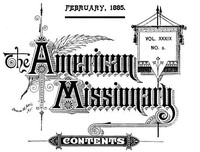
The American Missionary — Volume 39, No. 02, February, 1885 by Various
This isn't a novel. The American Missionary is a monthly journal, and this issue from February 1885 is a collection of letters, reports, and financial statements from missionaries and teachers, mostly working in the post-Civil War American South and with immigrant communities in the North.
The Story
There's no traditional plot. Instead, you get a mosaic of voices. A teacher in Tennessee details her 60 students—former slaves and their children—crammed into a drafty church, learning to read with a handful of ragged primers. A minister in Alabama pleads for more funding, describing the hostility from white neighbors who oppose education for Black citizens. Another report celebrates a new schoolhouse being built, while a financial page starkly shows how little money they actually have. The 'story' is the day-to-day struggle of the American Missionary Association to establish schools, churches, and a sense of citizenship in a deeply divided nation. The tension comes from reading between the lines—the courage in these reports sits right beside an often paternalistic attitude, creating a complex picture of Reconstruction-era idealism.
Why You Should Read It
I picked this up expecting dry religious tracts, but it gripped me. The power is in the concrete details. You don't get abstract theories about race or reconciliation; you get a list of textbooks needed, the price of lumber for a new desk, and a worried note about a teacher's safety. It makes history human. You feel the sheer audacity of their project and the immense obstacles they faced. It also doesn't shy away from the contradictions of the era—these are people doing what they see as righteous work, yet their language and assumptions can be hard to read today. That friction is what makes it so valuable. It doesn't let you have easy heroes or villains; it shows a messy, difficult attempt at progress.
Final Verdict
This is a specialist's treasure, but also fascinating for any curious reader. It's perfect for history buffs who want to move beyond textbooks and hear the immediate, unpolished voices from the ground. If you're interested in the roots of American education, social justice movements, or the complex aftermath of the Civil War, this primary source is incredibly revealing. A word of caution: it's not a light read. The prose is formal 19th-century reportage, and the subject matter is heavy. But if you're willing to sit with it, you'll get a raw, unforgettable look at a nation trying, fitfully and imperfectly, to heal itself.
There are no legal restrictions on this material. Preserving history for future generations.
Jackson Scott
1 year agoAfter finishing this book, the character development leaves a lasting impact. A valuable addition to my collection.




Jessica Ramirez
1 year agoThe fonts used are very comfortable for long reading sessions.