
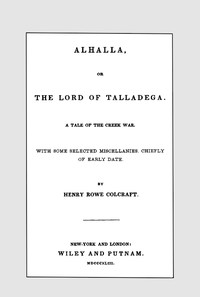
Alhalla, or the Lord of Talladega: A Tale of the Creek War. by Schoolcraft
Let's be honest, most of us learned about early American wars from a very specific angle in school. 'Alhalla, or the Lord of Talladega' flips that script. Written by Henry Rowe Schoolcraft—an actual explorer and ethnologist who traveled the region—this 1843 novel uses fiction to explore the very real tragedy of the Creek War (1813-1814).
The Story
The book centers on Alhalla, a leader of the Creek people in what is now Alabama. His world is under immense strain. American settlers are encroaching on Creek lands, and tensions are boiling over into violence. The story isn't just about the battles, like the infamous Fort Mims massacre or Andrew Jackson's campaigns. It's about the internal civil war among the Creeks themselves. Alhalla is part of the Red Sticks faction, who want to resist American expansion and return to traditional ways. He's pitted against other Creek leaders who see accommodation as the only path to survival. We follow his struggle as he tries to protect his people, his culture, and his own sense of honor against an unstoppable tide.
Why You Should Read It
This book is a fascinating, flawed, and important artifact. Schoolcraft had firsthand knowledge of Native American cultures, and that shows. He tries, within the limits of his 19th-century perspective, to present the Creek side of the story with dignity and complexity. Alhalla isn't a savage or a noble stereotype; he's a man making impossible choices. The prose can feel dated, but that's part of its power—you're reading a contemporary account of how people back then grappled with this history. It makes you question the tidy narratives we're often given. You feel the weight of loss, not just of land, but of an entire way of life.
Final Verdict
This isn't a breezy beach read. It's for the curious reader who loves history but wants to look beyond the textbook. It's perfect for anyone interested in early America, Native American history, or the messy, human stories behind our national myths. If you enjoyed the moral complexity of books like Blood Meridian or the historical depth of Bury My Heart at Wounded Knee, you'll find a compelling, earlier voice here. Approach it as a conversation with the past—one that is challenging, sobering, and absolutely worth having.
This is a copyright-free edition. It is available for public use and education.
Donna Brown
11 months agoWow.
Susan Wilson
11 months agoEssential reading for students of this field.
Emily Scott
3 weeks agoI didn't expect much, but the author's voice is distinct and makes complex topics easy to digest. Don't hesitate to start reading.