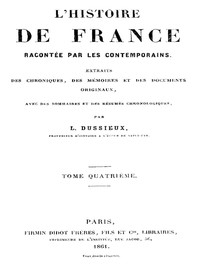
L'Histoire de France racontée par les Contemporains (Tome 4/4) by L. Dussieux
Let's be clear: this isn't a novel with a single plot. L'Histoire de France racontée par les Contemporains is a different kind of story. It's the story of a nation told through thousands of tiny, personal fragments. Think of it as the ultimate historical mosaic.
The Story
This fourth and final volume throws you directly into the storm. It starts with the powder keg of the late 18th century and follows the explosion through the French Revolution, the rise and fall of Napoleon, and the turbulent 19th century that followed. But you're not following a historian's narrative. Instead, you jump from a fiery speech by Danton to a weary entry in a soldier's diary during the Napoleonic Wars. You read the hopeful proclamations of revolutionary assemblies right alongside the confused and frightened letters sent by aristocrats fleeing for their lives. The book doesn't tell you what happened; it shows you through the words of the people who lived it, in all their contradiction and passion.
Why You Should Read It
This is why I loved it: it destroys the myth of history as a neat, agreed-upon story. Reading a soldier's blunt account of the misery of a campaign makes the grand 'glory of Empire' feel hollow. Seeing the Revolution described by a Parisian shopkeeper and a provincial priest side-by-side shows there was never one 'French experience.' It's challenging, sometimes uncomfortable, and always fascinating. You have to piece the truth together yourself from these conflicting voices. It turns history from something you memorize into something you actively investigate.
Final Verdict
This book is not for someone looking for a quick, easy recap. It's a commitment. But if you're a history lover who's tired of the same old summaries and wants to feel the texture of the past—the fear, the hope, the sheer confusion—this is a treasure. Perfect for readers who enjoy primary sources, have a deep interest in French history, and don't mind doing a bit of the interpretive work themselves. It's less of a book you simply read, and more of an archive you explore.
This content is free to share and distribute. It serves as a testament to our shared literary heritage.