
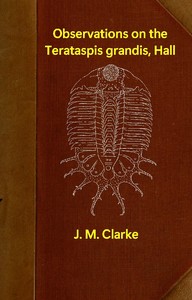
Observations on the Terataspis grandis, Hall, the largest known trilobite by Clarke
Okay, let's set the scene. It's 1888. Dinosaurs are the hot new thing in paleontology, but John Mason Clarke is obsessed with something older and, in his view, just as magnificent: trilobites. This short book—really a detailed scientific paper—is his report on the Terataspis grandis, a trilobite so large its fossilized segments are like rocky dinner plates.
The Story
There isn't a plot in the traditional sense. Instead, Clarke is our guide on a fossil investigation. He starts by introducing these monstrous, spiny fragments found in New York State. The core of the 'story' is the challenge: no one has ever found a complete Terataspis. Clarke has to play fossil detective, comparing his pieces to smaller, more complete trilobites to guess what the whole animal looked like. He meticulously describes every ridge and spine, arguing why his interpretation is correct. You can feel his frustration and excitement as he builds his case, piece by incomplete piece, against the silent backdrop of deep time.
Why You Should Read It
What makes this old paper special is the human voice behind the science. This isn't a sterile, modern journal article. Clarke's personality shines through. He's clearly in awe of his subject, calling it 'the largest and most magnificent of its tribe.' You can sense his pride in describing it and his determination to get it right. It's a snapshot of science in action—full of careful observation, but also bold speculation and polite academic rivalry. Reading it, you get a double history lesson: one about a prehistoric creature, and another about how a 19th-century scientist thought and worked.
Final Verdict
This is a niche read, but a rewarding one. It's perfect for fossil enthusiasts, history of science buffs, or anyone who enjoys real-life detective stories. Don't go in expecting a narrative book; go in expecting to sit on Clarke's shoulder as he puzzles over these incredible stones. It's short, focused, and offers a direct, unfiltered connection to the moment a scientist tried to bring a true ancient giant back to life, if only on the page. A little window into a huge, forgotten world.
This publication is available for unrestricted use. Preserving history for future generations.
Ashley Harris
1 year agoHonestly, the content flows smoothly from one chapter to the next. Truly inspiring.
Oliver Walker
1 year agoVery helpful, thanks.
Ava Johnson
11 months agoGood quality content.
Edward Hill
1 month agoNot bad at all.


Deborah Davis
1 year agoEnjoyed every page.