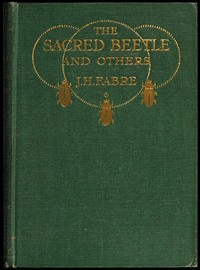
The Sacred Beetle, and Others by Jean-Henri Fabre
Let's clear something up right away: there is no traditional plot here. No heroes, no villains (well, maybe the predatory wasps qualify). Instead, the 'story' is the patient, year-long observation of insects in Fabre's own patch of land in Provence, which he called his 'open-air laboratory'. Each chapter focuses on a different creature: the titular Sacred Beetle (the dung beetle), the industrious mason bees, the cunning hunting wasps, and more.
The Story
Fabre doesn't just describe what he sees; he sets up experiments. He moves the beetle's dung ball to see if it can find it (it can). He interferes with the mason bee's nest to test its instincts. He watches, for hours, as a wasp performs precise surgery on a caterpillar to turn it into living, paralyzed food for its young. The narrative is driven by his curiosity and his constant questioning of 'why?' and 'how?'. He's piecing together the logic of a world that operates on rules utterly foreign to our own.
Why You Should Read It
This book is a masterclass in paying attention. In our fast-paced world, Fabre's slow, meticulous focus is revolutionary. He finds epic drama in a beetle's struggle to right itself, and profound engineering in a spider's web. His writing isn't cold or clinical; it's full of wonder, occasional frustration, and dry humor. He gives the insects personality—the beetle is a 'sturdy labourer,' the wasp a 'skilled surgeon'—without being silly about it. You start to care about their tiny struggles. More than anything, it shatters the illusion that intelligence and complex behavior belong only to creatures with backbones. The real magic is how it makes you feel: suddenly, your backyard or a city park is transformed into a stage teeming with incredible, ancient stories.
Final Verdict
This is for anyone with a spark of curiosity about the natural world. It's perfect for gardeners, for parents who want to show their kids the wonder in a worm, for fans of quiet, thoughtful nonfiction like 'The Hidden Life of Trees,' or for anyone who just needs a reminder to slow down and look closely. If you think bugs are icky or boring, this book might just be the best challenge you'll ever accept. It's a timeless, humbling, and genuinely exciting look at the small engineers who run the world.
This text is dedicated to the public domain. Use this text in your own projects freely.